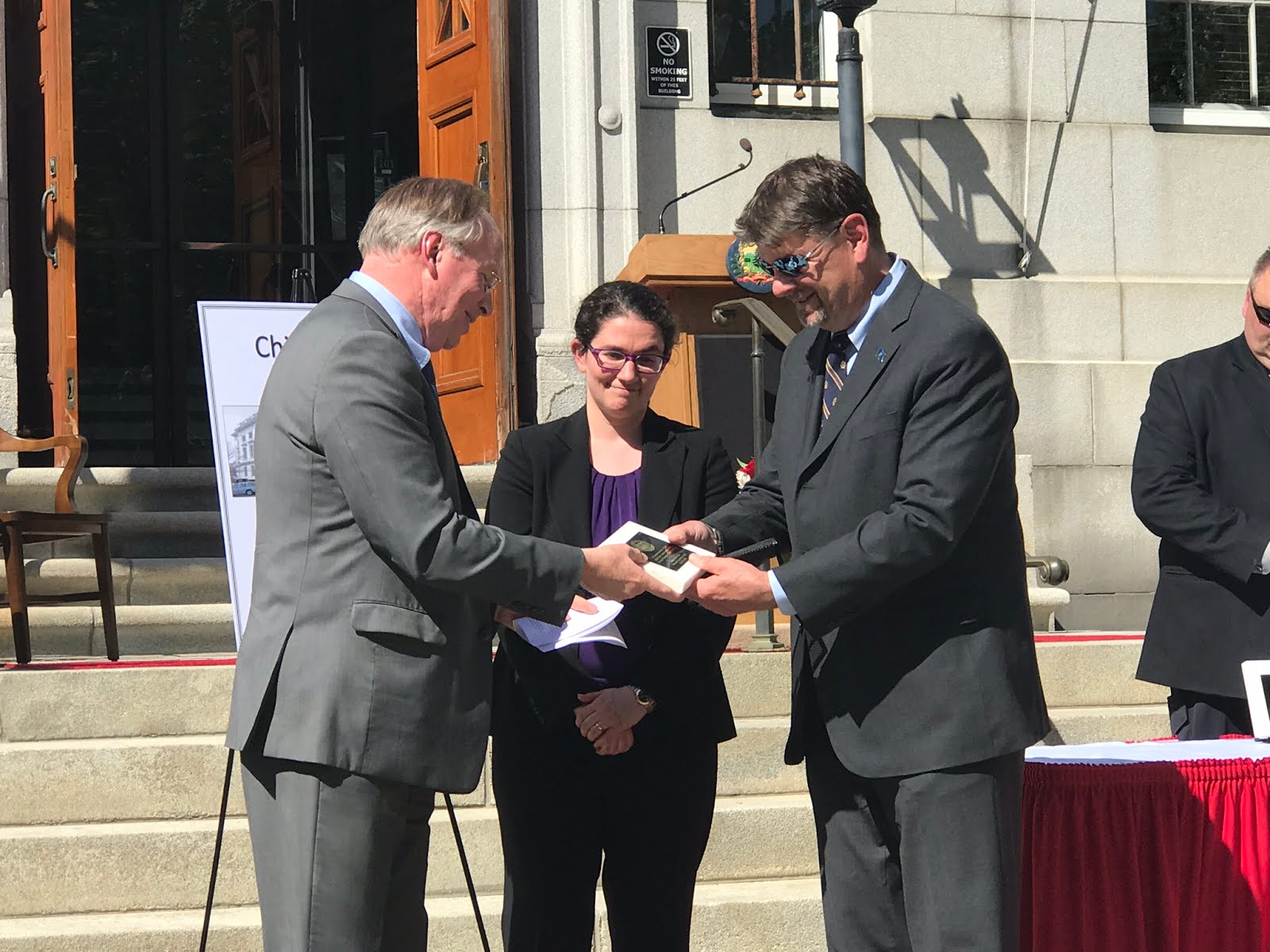
On the 100-year anniversary of the Vermont Supreme Court
Building, many gathered on the front lawn of the Supreme Court on Friday
afternoon to celebrate the bench and bar’s role in preserving the rule of
law. The ceremony was well-attended on
what turned out to be an incredibly warm and sunny day.
Chief Justice Paul Reiber conducted the ceremony as emcee, with
Governor Phil Scott to speak first after the Chief’s opening remarks. Governor
Scott praised judges and lawyers alike for preserving the rule of law and how
important the role of the judiciary is, regardless of politics. Governor Scott noted how honored he has been
to appoint many judges as well as Justice Carroll, whose appointment gave the
Vermont Supreme Court a female majority for the first time in history.
These remarks garnered applause and made a
perfect segue for House Judiciary Committee Chairwoman Rep. Maxine Grad to
speak next. Representative Grad spoke of
the separation of powers, remarking how her work just up the hill is subject to
review by the Court, while the Court takes into consideration the legislative
intent and will of the people when it interprets the laws just down the hill.
It is this separation and review that protects the rule of law.
Before turning the ceremony over to the individual counties,
Justice Reiber pointed out the plaque just next to the building commemorating
the landmark civil union decision. He
also read the remarks sent by Senators Leahy and Sanders, sending their warmest
congratulations on 100 years of furthering justice. They remarked how lawyers protect equality
among citizens and sent best wishes for the next 100 years of fostering respect
for the rule of law.
Justice Reiber spoke next, noting how Supreme Court business
was originally conducted rotating hearings among courthouses in shire towns.
The ceremony proceeded to go through a brief history of each county, in order
of establishment, with VBA President Dan Maguire presenting each county’s
presiding judge and County Bar President with a marble plaque, made of marble
from the original Court’s construction. Each
presiding judge, or designee, read fascinating stories about the birth of their
county and its courthouse. More detail for each county and their landmark cases
can be found in Paul Gillies’ essay, HERE.
First up was Bennington County.
After Vermont departed from being a part of New York’s Albany
County, Vermont’s first legislature divided Vermont into two counties:
Bennington and Cumberland. The courts
first met at the Catamount Tavern in Bennington. The original Supreme Court alternated between
the two shires of Bennington and Manchester.
All of the towns in Windham County were part of Cumberland
County originally. The Westminster
Courthouse was built in 1772, although the court was prevented from opening in
1775 in the Westminster Massacre. Westminster remained the first County shire
until the court moved to Newfane.
In 1781, Bennington County was split into two parts, one
being Rutland County. Tinmouth was the
first shire of Rutland County and the court met at Solomon Bingham’s Public
House. Judge Hoar noted the theme of
courts meeting in taverns originally, and also noted that the present
courthouse was constructed at a cost of only $12,000 in 1871.
While originally Newbury was the shire of Gloucester County
and remained the first shire of the newly formed Orange County, Chelsea was
named the shire town of Orange in 1796.
The first courtroom was built after court was originally held in
Heaton’s tavern in Thetford.
After the creation of Windsor County in 1781, the court met
regularly but moved from town to town until Woodstock was appointed by the
legislature to be the first shire town in 1786.
The present courthouse was constructed in 1787 at a cost of $14,000.
In Addison, the court met in private homes and taverns in
Addison for several years until the court removed to Middlebury in 1791. The first courthouse was constructed by
subscription, funded by the citizens, in 1798.
Addison County was divided in 1787 to create Chittenden
County, with court being held at the home of Ira Allen in first shire town of
Colchester. Burlington became the shire
in 1790 and the first court meeting was at the tavern of Gideon King on Battery
Street.
When
Caledonia County was formed in 1792, the question of which town would serve as
the shire was undecided. Danville and Peacham competed for the honor, and the
legislature left the decision to the voters in the town who would bear the cost
of the county buildings. Peacham decided against the expense, and Danville was
chosen in 1796.
Orleans
County was formed in 1792 out of northern Orange County. Commencing in 1800, the court opened in
Craftsbury and the following year, the court met at Brownington, alternating between
the two half-shires until 1816, when Irasburgh had completed a courthouse and
jail to become the sole shire of Orleans County. In 1886, the courts were
transferred to Newport, the new shire, due to its railroad access.
Franklin
was carved out of northern Chittenden County in 1792. The present courthouse was completed in 1879
at a cost of $50,000. Like Orleans,
Essex was also carved out of northern Orange County in 1792. Lunenburgh and Brunswick were half-shires of
Essex until Guildhall was made shire in 1802, with the courthouse built on
donated land but with construction funded by a property tax. Grand-Isle was established in 1802, carved
out of Franklin County. The first court session was held in 1806 at a hotel
ballroom in North Hero, and the courthouse was completed in 1824.
Montpelier
became the Capital City in 1808 and two years later became the shire town of
Jefferson County, newly formed from parts of Orange, Addison, Chittenden, and
Caledonia counties. In 1810, as a direct
response to the embargo, Jefferson County was renamed Washington County. At first, the court met at the State House,
then in a courthouse on the Capitol grounds. The present courthouse was
constructed in 1880.
Lamoille
County was the last county to be formed in Vermont, in 1836, out of towns from
Chittenden, Franklin, Washington, and Orleans Counties, at the same time as the
Vermont Senate was established. The idea was a county that was neither east nor
west, and arguably wouldn’t side with one region or the other. The Hyde Park Courthouse, opened in 1918 and
recently renovated, stands in the center of the village.
After
all the county judges and bar representatives gave their brief county histories
and received their plaques, Chief Justice Reiber returned to the podium to
praise all the courts for all their hard work and dedication to serving justice
for the past 240 years. He then called
up Paul Gillies, and the Chief and VBA Executive Director Teri Corsones gave
Paul Gillies a commemorative plaque showing appreciation for Paul’s
contributions to the ceremony, including researching the county histories,
writing the commemorative essay, preparing the trial re-enactment and materials
and acting as general historian for the event.
Justice Reiber then gave Jean Crockett a plaque as a thank you to Jean
and all of the Building and Grounds Services for their help with preparing the
building and grounds for the event.
Everyone was invited to attend the re-enactment of the oral
argument of Dodge Brothers v. Central
Vermont Railway, one of the cases heard in 1918 on the first day that 111 State
Street was first used by the Vermont Supreme Court. Of
course, no event is complete without refreshments and the Court and VBA
delivered with a variety of food items, refreshing punch and, as always, an
amazingly large and delicious commemorative cake made by VBA’s own Teri
Corsones.
Please enjoy all the pictures from the event, below. The video recording of the entire ceremony is HERE.